Our Better Angels considers empathy and division through reworked flags, ceramic vessels, and hybrid animal figures. It places ideals of peace, liberty, and equality beside the forces that distort or deny them.
Materials
Ceramic, silkscreen, installation, and audio
Exhibition
SHIFT Gallery
Seattle, 2025

Our Better Angels: J6, 2025, acrylic image transfer on aluminum dibond, chain, vinyl.

Our Better Angels 1, 2025, glaze on mid-range stoneware, cone 5.

Our Better Angels, installation view, 2025, SHIFT Gallery, Seattle.

Our Better Angels 2, 2025, glaze on mid-range stoneware, cone 5.

Our Better Angels, installation view, opening reception, 2025, SHIFT Gallery, Seattle.

Our Better Angels 3, 2025, glaze on mid-range stoneware, cone 5.

Our Better Angels 4, 2025, glaze on mid-range stoneware, cone 5.

Our Better Angels (triptych), 2025, printed nylon flag, acrylic image transfer on aluminum dibond.

Our Better Angels: J6, 2025, acrylic image transfer on aluminum dibond, chain, vinyl., detail

Our Better Angels: J6, 2025, acrylic image transfer on aluminum dibond, chain, vinyl., detail

Our Better Angels 5, 2025, glaze on mid-range stoneware, cone 5.

Our Better Angels, installation view, opening reception, 2025, SHIFT Gallery, Seattle.

Our Better Angels: Nine Stages of Freedom, 2025, silkscreen print edition, matte black vinyl.

Our Better Angels 6, 2025, glaze on mid-range stoneware, cone 5.

Our Better Angels: J6, 2025, acrylic image transfer on aluminum dibond, chain, vinyl., detail

Our Better Angels 7, 2025, glaze on mid-range stoneware, cone 5.
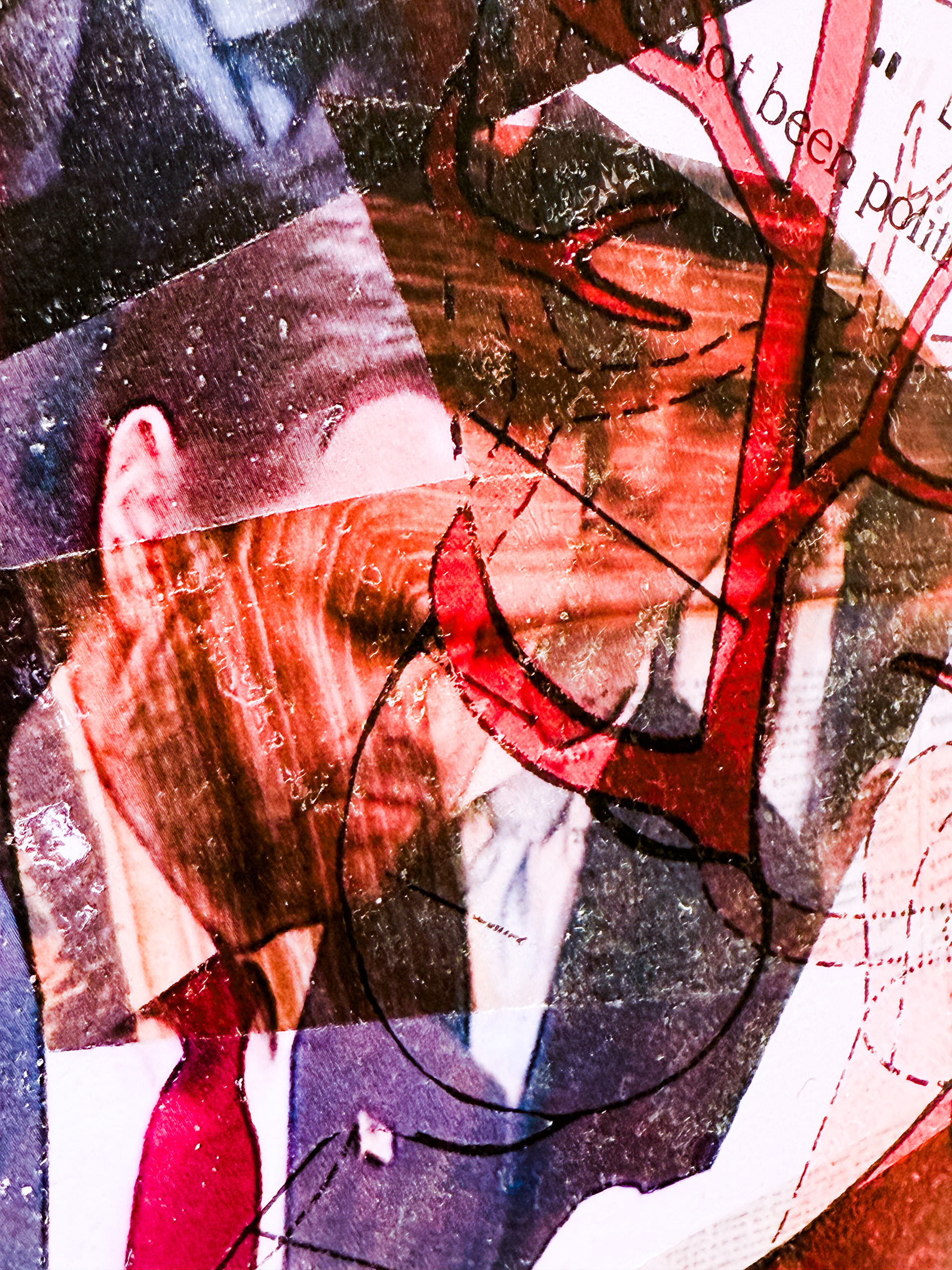
Our Better Angels: J6, 2025, acrylic image transfer on aluminum dibond, chain, vinyl., detail.

Our Better Angels: It Wasn’t Very Good, 2025, acrylic image transfer on aluminum dibond.

Our Better Angels: Nine Stages of Freedom, 2025, silkscreen print edition, matte black vinyl, detail.

Our Better Angels 8, 2025, glaze on mid-range stoneware, cone 5.
Our Better Angels
At the center is the middle path, informed by both Buddhist thought and Jesuit social justice traditions. These influences guide van den Bosch's effort to stay with complexity while seeking shared ground, dignity, and accountability amid political divisions. The fragmented star may converge into one path or split apart. It suggests a peace symbol without its circle and evokes the legislative, executive, and judicial branches of government. The missing lower point represents the judiciary, inviting people to participate in the country’s work of judgment and accountability.
Van den Bosch reinterprets and reclaims visual elements from early American flag designs and flags used by states that seceded during the Civil War. He does not identify with or endorse secession or the Confederacy’s defense of slavery. He transforms these symbols in the hope that they might better represent the ideals this country should uphold for everyone. The title comes from Abraham Lincoln’s First Inaugural Address, delivered as states were seceding. His appeal for the Union closed with a call to the “better angels of our nature.”
On the containers, the fragmented stars have a loose visual resonance with Pacific Northwest formline design. Van den Bosch acknowledges this as an influence, not a model to copy, recognizing that these traditions carry cultural significance, visual hierarchies, and meanings beyond his work. Here, the fragments are his own reimagining of the star. They evoke the many pieces, people, and contributions that shape the country and its ideals, with the hope of a more equitable present and future for all citizens.
The containers also feature reconfigured animals, formed by combining different creatures. Their associations are layered: a rabbit can suggest renewal and vulnerability; angel wings, protection or transcendence; an owl, wisdom and watchfulness; a goose, vigilance; and a rooster, courage and the arrival of a new day. A priestly robe evokes spiritual authority. The rooster with a goose head brings distinct animal qualities together in one figure. These are not fixed meanings. The hybrid forms invite viewers to consider new emblems and the qualities they might carry, such as freedom, tenacity, resilience, and fortitude.
The silkscreen presents nine repeated impressions of the reimagined flag, with nine stages of inner freedom beneath them, drawn from Joseph Naft’s Stages of Freedom. Naft was born in a war refugee camp in northern Italy in the aftermath of World War II. His biography describes a lifelong concern with human violence and spiritual practice. The sequence places the country’s public ideals beside an inward process of becoming free.
In the silkscreened imagery, forms can read as buildings and bombs, or as food and shelter growing from the ground. Which interpretation emerges is up to the viewer; the symbols function a little like a Rorschach. Seen now, the January 6 imagery is sharpened by Trump’s return to office and sweeping clemency for more than 1,500 people connected to the attack. For van den Bosch, this signals that political violence and attempts to overturn an election can ultimately be excused. The work insists that democratic ideals require accountability from leaders and those who act in their name.
Van den Bosch shaped the Dibond stars with a CNC router. Their surfaces carry several hundred overlapping acrylic-transferred images, drawn from screenshots he took on his phone during Trump’s second inauguration and the opening days of his presidency. They record technology leaders gathering around him, a moment van den Bosch interpreted as accompanied by a more performative, macho display of power. Other images capture announcements such as the January 6 pardons and public conversations responding to the administration’s early actions. In the piece focused on those pardons, a red chain runs through the composition. Its color signifies the bloodshed by those defending Congress and democracy on January 6 against the would-be insurrectionists.
While taking a live Zoom workshop through the School of Song featuring Brian Eno, van den Bosch wrote and recorded “A Future Without Fear” specifically for this exhibition and its themes.